The search for facial paralysis causes often appears when a person notices sudden weakness on one side of the face, difficulty closing one eye, an asymmetrical smile, or loss of muscle control. Although it is often associated with Bell’s palsy, not all facial paralysis cases have the same origin or require the same approach.
Facial paralysis may be caused by inflammation of the facial nerve, infections, trauma, surgery, tumors, neurological diseases, or vascular disorders. For this reason, the goal should not be to self-diagnose, but to recognize warning signs, understand the most common causes, and know when to seek medical assessment. The information in this article is for guidance only and may vary depending on age, medical history, symptom progression, and clinical examination.
What is facial paralysis?
Facial paralysis is the partial or complete loss of movement in the facial muscles. It may affect one side of the face or, much less commonly, both sides. When the facial nerve does not properly transmit signals to the muscles, symptoms may include drooping of the corner of the mouth, difficulty closing the eyelid, altered tearing, changes in taste, or discomfort around the ear.
The facial nerve, also known as the seventh cranial nerve, controls much of facial expression and is involved in functions related to taste and sensitivity around the ear area. In Bell’s palsy, one of the most common causes, symptoms usually appear quickly, and many people recover part or all of their facial function over a period of weeks to several months.
It is important to distinguish between peripheral facial weakness and other neurological conditions. Paralysis affecting the face does not always originate in the peripheral facial nerve; it may also be related to a brain, vascular, or systemic problem. That is why the onset pattern, accompanying symptoms, and medical examination are key.
Main causes of facial paralysis
The expression facial paralysis causes includes very different situations. The best known is Bell’s palsy, which is considered an acute-onset peripheral facial paralysis with an often unidentified cause. It is believed to be related to inflammation of the facial nerve, often after a reaction associated with viral infections, although a clear trigger is not always confirmed.
In addition to Bell’s palsy, there are other causes that should be taken into account. Some are mild or temporary, but others require urgent diagnosis and treatment. These may include ear infections, otic herpes zoster, head or facial trauma, surgical complications, tumors compressing the facial nerve, inflammatory diseases, Lyme disease in risk areas, diabetes, pregnancy, or stroke.
Common causes and causes that require closer attention
- Bell’s palsy: it is usually unilateral, sudden in onset, and with no obvious cause in many cases.
- Infections: otitis, herpes zoster, viral infections, or inflammatory processes near the facial nerve.
- Trauma: blows, temporal bone fractures, or facial injuries.
- Tumors or compression: masses in the parotid region, ear, skull base, or along the path of the nerve.
- Stroke or other neurological problems: especially if there is weakness in an arm or leg, difficulty speaking, or altered consciousness.
In content about Facelift in Marbella, it is important to clearly distinguish between cosmetic procedures and neurological disorders. Facial asymmetry caused by aging, skin laxity, or previous surgery is not interpreted in the same way as a sudden loss of facial mobility, which should always be assessed with medical judgment.
How can Bell’s palsy be distinguished from a stroke or other problems?
Bell’s palsy usually affects the muscles on one side of the face, including the forehead, and may make it difficult to close the eye on the affected side. By contrast, some strokes may cause mouth deviation while partially preserving forehead movement. Even so, this difference is not always enough to decide at home what is happening.
The most important sign is the sudden appearance of associated neurological symptoms. If facial weakness is accompanied by loss of strength in an arm or leg, difficulty speaking, confusion, vision loss, severe headache, sudden dizziness, or gait disturbance, it should be treated as an emergency. In these cases, you should not wait to see whether it improves.
You should also seek medical advice promptly if there is severe ear pain with blisters, hearing loss, vertigo, fever, involvement of both sides of the face, progressive worsening over several weeks, or a history of cancer, trauma, or recent surgery.
Warning signs
- Sudden onset with neurological symptoms: difficulty speaking, loss of strength, confusion, or visual disturbance.
- Severe pain or lesions in the ear: this may suggest infection or otic herpes zoster.
- Bilateral involvement: this is uncommon and requires specific investigation.
- Progressive worsening: if it worsens over several weeks, compression or another cause should be ruled out.
- Inability to close the eye: this increases the risk of dryness and corneal injury.
Medical diagnosis and common tests
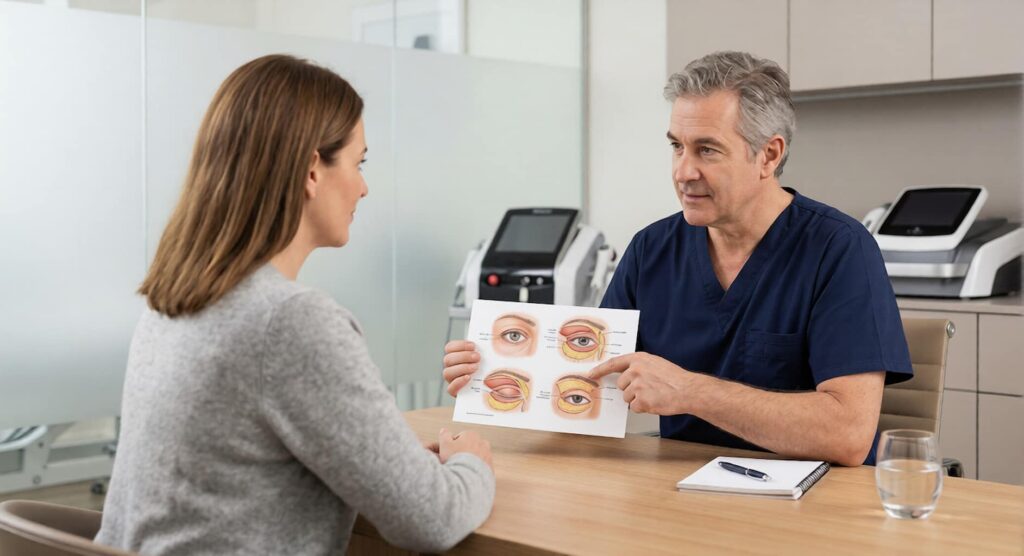
Diagnosis begins with a detailed medical history: when the weakness started, whether it appeared suddenly or progressively, which area of the face is affected, whether there is pain, changes in taste, fever, skin lesions, hearing loss, vertigo, recent trauma, or neurological symptoms. This is followed by a facial and neurological examination and, in many cases, an examination of the ear, nose, and throat.
In typical Bell’s palsy, the diagnosis may be clinical. However, if there are atypical symptoms, prolonged progression, or suspicion of another cause, complementary tests may be indicated, such as blood tests, magnetic resonance imaging, computed tomography, hearing studies, electromyography, or specific tests depending on the context.
In medicine, useful data are not physical parameters such as the dimensions of a crane truck, length/width/height, maximum measurements, total height, operating width, stabilizers, or turning radius. In facial paralysis, other indicators matter: duration of symptoms, degree of mobility, ability to close the eye, pain, associated symptoms, medical history, and response to treatment.
The term Marbella Facelift may appear in content related to facial rejuvenation, but facial paralysis belongs to a different clinical field. When there is loss of mobility, the analysis should focus on the facial nerve, muscle function, eye protection, and possible medical causes.
What treatments and care help with recovery?
Treatment depends on the cause. In Bell’s palsy, management may include corticosteroids during the first few days, eye protection, lubrication with artificial tears, and monitoring of the progression. In selected cases, antivirals may be considered, but the approach must be individualized. Eye care is essential when the eyelid cannot close properly, because the cornea can dry out or become injured.
When the cause is an infection, trauma, tumor, neurological disease, or surgical complication, treatment changes. For this reason, it is not advisable to perform intense exercises, aggressive massages, or use devices without a diagnosis. Early and well-directed intervention can reduce risks, especially in eye care and facial rehabilitation.
Specialized physiotherapy may be useful in certain patients, especially if there is persistent weakness, abnormal movements, or difficulty recovering coordination. Exercises must be adapted to the degree of involvement; applying too much force or repeating uncontrolled movements may not be beneficial in all cases.
Basic care during the first few days
- Protect the eye: use lubrication if there is dryness and follow medical instructions to prevent corneal damage.
- Do not self-medicate: especially with corticosteroids, antivirals, or eye drops without professional assessment.
- Monitor the progression: write down the onset date, changes, pain, and associated symptoms.
- Avoid aggressive manipulation: massages or exercises should be prescribed if there is significant involvement.
- Seek advice if symptoms worsen: especially if new neurological symptoms or severe pain appear.
Recovery, after-effects, and when to review the case
Progress varies depending on the cause and the initial severity. In Bell’s palsy, many people begin to improve during the first few weeks, and recovery may be completed over several months. Even so, some patients may experience residual weakness, spasms, synkinesis, abnormal tearing, or persistent discomfort.
If there is no improvement after a few weeks, if the weakness progresses, if new symptoms appear, or if the paralysis does not fit a typical pattern, the diagnosis should be reviewed. Inability to close the eye, severe pain, bilateral involvement, or progressive worsening are reasons not to delay consultation.
In related articles such as latest blog: “risks of eyelid surgery”, eye safety and eyelid closure function are also relevant topics. In facial paralysis, this point is even more important because lack of eyelid closure can leave the ocular surface exposed for hours.
In summary, the search for facial paralysis causes should be approached with caution. It may be Bell’s palsy with a favorable outcome, but it may also be due to infections, trauma, compression, neurological diseases, or urgent situations. The key is to assess the onset, accompanying symptoms, ability to close the eye, progression, and risk factors. In the event of sudden facial weakness or neurological signs, the priority is prompt medical assessment.